How the Oracle Network Works

Three provider types, three aggregation pipelines, one master contract. Here's how climate data goes from satellite to smart contract.


Data Sources

Satellite: NASA · ESA · NOAA · JAXA  |  Field: Shamba Mobile App  |  Expert: Domain Specialists

Node Operators
Cloud SDK
Ground Truthers
Mobile App
Data Validators
Expert Review

All require staking · Support delegated staking · Randomly selected per request

Node Aggregation
Ground Truth Aggr.
Validation Aggr.

Separate pipelines per provider type → Master Aggregation Contract

Master Aggregation
Staking & Delegation
Credibility Scoring
Governance

Final verification · Reward providers + delegators · Slash bad actors · Provider rankings

Parametric Insurance
Carbon Credits
Prediction Markets
Green Bonds

Open-Source Data Pipeline

An optimized Docker container deployed to the cloud. Everything needed to operate a Shamba node — deploy within minutes on any supported cloud platform. On-demand execution keeps costs low.

NDVI Computation

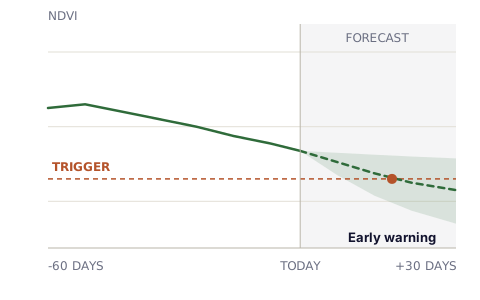
Calculate the Normalized Difference Vegetation Index for any area of interest using MODIS and Sentinel data, with descriptive statistics (mean, max, min, median, variance).

Rainfall Monitoring

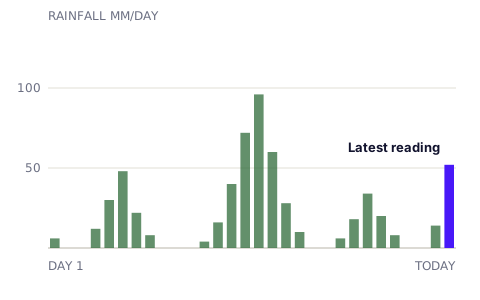
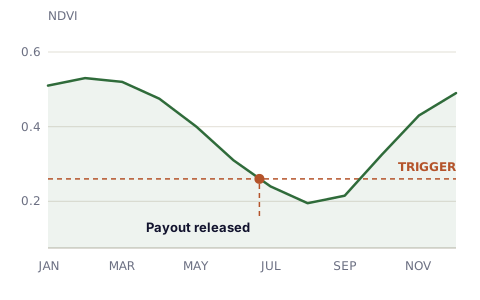
Near real-time rainfall analysis enhanced by AI models. Feeds parametric insurance contracts that trigger automatic payouts when thresholds are crossed.

Soil Carbon Estimation

Estimate soil organic carbon from satellite imagery to enable smallholder farmers to create and sell carbon credits through automated dMRV pipelines.

Fire Detection

Detect and monitor wildfires using thermal satellite imagery. Developers integrate via the ShambaFireConsumer smart contract for on-chain fire alerts.

Land Use Classification

Classify land cover types to verify sustainable farming practices, track deforestation, and validate environmental impact claims for ecocredit programs.

Node Operations & CLI

Automated response to data requests, cryptographic signing of results, staking management, health monitoring, and a CLI for operators. Runs on Linux, macOS, and Windows.

30+ Satellite Databases

Every node accesses the same public satellite APIs — deterministic, reproducible, and independently verifiable by any participant.

NASA

MODIS and Landsat satellites providing vegetation indices, land surface temperature, and multispectral imagery with global coverage.

ESA

Copernicus Sentinel constellation for high-resolution land monitoring, vegetation health tracking, and environmental change detection across Europe and Africa.

NOAA

Atmospheric and weather data feeds providing rainfall measurements, temperature records, and climate monitoring critical for parametric insurance triggers.

JAXA

Japan Aerospace Exploration Agency's Earth observation data providing complementary coverage for vegetation, precipitation, and land surface analysis.

Consensus & Aggregation

No single provider controls the outcome. Separate aggregation pipelines for each data type converge in a master contract. Manipulation becomes economically irrational.

1

Random Selection

The protocol randomly selects n node operators, m ground truthers, and k data validators from pools of staked providers. No one knows in advance if they will be chosen.

2

Independent Data Collection

Node operators fetch satellite data. Ground truthers collect field measurements via the Shamba mobile app. Data validators review edge cases. Each works independently.

3

Multi-Layer Aggregation

Three aggregation services (node, ground truth, validation) process submissions independently. A master aggregation contract combines all layers into the final verified result.

4

Rewards & Slashing

Accurate providers and their delegators earn token rewards. Providers who submit bad data are slashed — along with their delegators. Credibility scores track long-term performance.

Why Climate Data Is Uniquely Suited to This Model

Public & Deterministic

Every node accesses the same NASA/ESA/NOAA/JAXA APIs. There is no proprietary data to hide behind — the source data is completely transparent.

Reproducible Computation

Given the same inputs and the same open-source pipeline, every honest node produces the same output. Discrepancies signal either bugs or attacks.

Well-Defined Tolerance

Small floating-point variations are normal and expected. Large deviations are clearly identifiable, making the consensus threshold straightforward to calibrate.

Multi-Layer Ground Truth

Satellite observations are cross-validated by ground truthers collecting field data and domain experts providing human review — three independent verification layers.

Supported Blockchains

Shamba delivers verified climate data across six major EVM-compatible networks, meeting developers where they already build.

Arbitrum

Live

Avalanche

Live

Ethereum

Live

Optimism

Live

Polygon

Live

XRPL EVM Sidechain

Live

Start Building in Minutes

Import the ShambaGeoConsumer contract from the npm smart-contract-kit and request verified climate data on-chain.

// SPDX-License-Identifier: MIT
pragma solidity ^0.8.17;

import "@shamba/smart-contract-kit/ShambaGeoConsumer.sol";

contract ClimateInsurance is ShambaGeoConsumer {

    uint256 public latestNDVI;
    uint256 public payoutThreshold;

    constructor(
        uint256 _threshold
    ) {
        payoutThreshold = _threshold;
    }

    function requestNDVI(
        string memory areaOfInterest,
        string memory startDate,
        string memory endDate
    ) public {
        requestGeoData(
            areaOfInterest,
            startDate,
            endDate,
            "ndvi",
            "mean"
        );
    }

    function fulfill(
        bytes32 requestId,
        uint256 result
    ) internal override {
        latestNDVI = result;
        if (result < payoutThreshold) {
            _triggerPayout();
        }
    }
}

Quick Start

# Install the smart contract kit
npm install @shamba/smart-contract-kit

Import ShambaGeoConsumer for vegetation, rainfall, and soil data or ShambaFireConsumer for fire detection feeds.

Request Parameters

  • areaOfInterest — GeoJSON polygon or coordinates
  • startDate / endDate — Time range (ISO 8601)
  • dataType — ndvi, rainfall, soil_carbon, fire, land_cover
  • statistic — mean, max, min, median, variance

Technical Specifications

Specification Details
Oracle Type Decentralized climate data oracle (DePIN model)
Node Software Open-source Docker container (GNU GPL / MIT / BSD licensed)
Deployment Cloud-deployed Docker container, optimized for on-demand execution
Data Provider Types Node operators (satellite), ground truthers (field/mobile), data validators (expert review)
Satellite Data Sources 30+ databases from NASA, ESA, NOAA, JAXA
Data Products NDVI, rainfall, soil organic carbon, fire detection, land use classification
Statistics Supported Mean, max, min, median, variance
Supported Chains Arbitrum, Avalanche, Ethereum, Optimism, Polygon, XRPL EVM Sidechain
Smart Contracts Solidity (ShambaGeoConsumer, ShambaFireConsumer)
Developer Kit npm @shamba/smart-contract-kit
Decentralized Storage Filecoin / IPFS for immutable MRV metadata
Consensus Model Multi-layer aggregation: node, ground truth, and validation services → master aggregation contract
Security Model Staking + delegated staking + slashing + multi-factor credibility scoring
Governance Progressive decentralization — token-holder voting on data sources, parameters, upgrades
Target Network Size 10–30 nodes (testnet), 100+ (post-mainnet)

Join the Network

Deploy a cloud node, collect field data, or apply your domain expertise. Three ways to provide data and earn rewards.

Join the Waitlist

Build on Shamba

Integrate verified climate data into your smart contracts. Parametric insurance, carbon credits, prediction markets, and more.

Read the Docs